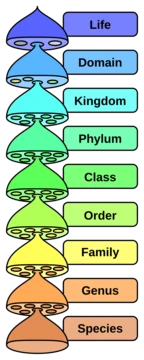
Life
Life is a self-sustained chemical system capable of Darwinian evolution.

Life is the capacity in matter, formed of one or more units called cells, for processes such as cell signaling, homeostasis, metabolism, cell growth, adaptation, response to stimuli, and reproduction. All life eventually reaches a state of death. The definition of life has long been a challenge for scientists and philosophers, partly because life is a process, not a substance, and due to complications from viruses and the possibility of extraterrestrial life.
- field
- Biology, Philosophy
- known_for
- Descriptive definitions of life, including homeostasis, organization, metabolism, growth, adaptation, response to stimuli, and reproduction
- key_traits
- Self-organizing, autopoietic, thermodynamic open system capable of Darwinian evolution
Lore & Background
Life has been studied since ancient times, with theories such as Empedocles's materialism asserting that it was composed of four eternal elements, and Aristotle's hylomorphism asserting that living things have souls and embody both form and matter. Life originated at least 3.5 billion years ago, resulting in a universal common ancestor. This evolved into all the species that exist now, by way of many extinct species, some of which have left traces as fossils. Attempts to classify living things began with Aristotle, and modern classification began with Carl Linnaeus's system of binomial nomenclature in the 1740s. Living things are composed of biochemical molecules, formed mainly from a few core chemical elements. All living things contain two types of macromolecule, proteins and nucleic acids, the latter usually both DNA and RNA. The cell is the structural and functional unit of life. Smaller organisms, including prokaryotes (bacteria and archaea), consist of small single cells. Larger organisms, mainly eukaryotes, can consist of single cells or may be multicellular with more complex structure. Life is only known to exist on Earth but extraterrestrial life is thought probable. Artificial life is being simulated and explored by scientists and engineers. From a physics perspective, an organism is a thermodynamic system with an organized molecular structure that can reproduce itself and evolve as survival dictates. Thermodynamically, life has been described as an open system which makes use of gradients in its surroundings to create imperfect copies of itself. Another definition, adopted by a NASA committee based on a suggestion by Carl Sagan, defines life as 'a self-sustained chemical system capable of undergoing Darwinian evolution.' This definition has been widely criticized because according to it, a single sexually reproducing individual is not alive as it is incapable of evolving on its own.
Reader's Guide
Life is a central concept in biology and philosophy, yet its definition remains contested. The source article emphasizes that life is a process, not a substance, and that descriptive definitions—including homeostasis, organization, metabolism, growth, adaptation, response to stimuli, and reproduction—are commonly used due to lack of consensus. The challenge is compounded by viruses, which replicate only in host cells and do not metabolize, and by the possibility of extraterrestrial life that could be very different from life on Earth. Legal definitions of life have been debated, though these generally focus on the decision to declare a human dead. The article also highlights that life originated at least 3.5 billion years ago and that all known life shares a universal common ancestor. The significance of life lies in its ability to self-organize, evolve, and form complex ecosystems, from extremophiles in harsh environments to the entire biosphere. The study of life has ancient roots, with materialist and hylomorphic theories, and continues to evolve with modern classification and artificial life simulations.
Did You Know?
- Life originated at least 3.5 billion years ago, resulting in a universal common ancestor.
- Viruses are often considered 'organisms at the edge of life' because they possess genes and evolve by natural selection but do not metabolize.
- A NASA committee adopted a definition of life as 'a self-sustained chemical system capable of undergoing Darwinian evolution,' based on a suggestion by Carl Sagan.
The Endless Debate Over a Definition
Life has resisted a single, tidy definition for as long as humans have tried to pin it down. More than one hundred and twenty-three distinct formulations have been collected over the centuries, yet no consensus has emerged. Part of the difficulty is that life is fundamentally a process rather than a substance, which makes it awkward to capture in a static description. Philosophers have proposed frameworks such as self-organizing systems, while legal scholars have wrestled with the practical question of when a human being can be declared dead and what consequences follow. Biologists, lacking a universally accepted definition, tend to rely on descriptive trait lists—homeostasis, metabolism, growth, adaptation, response to stimuli, and reproduction—as working criteria. The problem deepens when one considers organisms like viruses, which can replicate only by hijacking a host cell, or the entirely unknown characteristics that any extraterrestrial life might display. The result is a field where the very subject of study remains, in a sense, perpetually undefined.
The Molecular Engine
Every living organism, from the smallest bacterium to the largest multicellular creature, is built from a relatively small set of core chemical elements assembled into biochemical molecules. Two families of macromolecules stand at the center of this architecture: proteins and nucleic acids. Nucleic acids—typically both DNA and RNA—serve as the information carriers, holding the instructions each species needs to construct its particular set of proteins. Those proteins, in turn, function as the molecular machinery that drives the countless chemical reactions underlying homeostasis, metabolism, growth, and reproduction. The cell is the fundamental structural and functional unit at which all of this operates. Prokaryotes such as bacteria and archaea exist as compact single cells, while eukaryotes range from solitary cells to vast multicellular organisms with intricate internal organization. In physics terms, an organism can be understood as an open thermodynamic system that exploits environmental gradients to produce imperfect copies of itself and, over time, to evolve.
Three and a Half Billion Years of Invention
Life on Earth traces its origins back at least 3.5 billion years, emerging from a single universal common ancestor whose descendants, through countless generations of evolution, gave rise to every species alive today as well as the vast number that have since gone extinct. Many of those lost lineages survive only as fossil traces embedded in rock. The intellectual history of understanding life is nearly as long. Ancient Greek thinkers offered early theories: Empedocles proposed that living matter was composed of four eternal elements, while Aristotle argued that living things possess souls and embody both form and matter. Aristotle also initiated the first serious attempts to classify organisms, a tradition that would not reach its modern form until the 1740s, when Carl Linnaeus introduced his system of binomial nomenclature. That framework gave scientists a shared language for naming and organizing the extraordinary diversity of life, a diversity that continues to be discovered and reclassified to this day.
Life at the Margins
Life on Earth is far more widespread and more resilient than casual observation might suggest. It inhabits air, water, and soil across the planet, weaving together into ecosystems that collectively form the biosphere. In some of the harshest corners—environments that would be lethal to most organisms—extremophiles thrive, reminding us that the boundaries of the possible are wider than intuition allows. The assemblage of living things in any given place and time is called its biota, and preserving that biota is a central aim of nature conservation. Yet life also exists in forms that blur the line between living and non-living. Viruses, for instance, can replicate only by commandeering a host cell, which complicates any clean definition. Beyond our planet, extraterrestrial life is considered probable by many scientists, though its nature remains entirely unknown. Meanwhile, in laboratories and on computer screens, engineers and researchers simulate and explore artificial life, pushing the question of what constitutes a living system into new territory.
Frequently Asked Questions
What is Life?
Life is the capacity inherent in cellular matter to carry out processes such as metabolism, growth, adaptation, and reproduction. Rather than being a single substance, it is fundamentally a self-sustained chemical system that operates across one or more cells.
What are Life's core traits or 'powers'?
Life functions as a self-organizing, autopoietic, thermodynamically open system capable of Darwinian evolution. It sustains itself through homeostasis, cell signaling, and responsive behavior while continuously adapting over time.
How does Life's story end?
Every living system, without exception, eventually reaches a state of death that halts its biological processes. This terminal endpoint is universal across all known life on Earth.
Why is Life so difficult to pin down with a single definition?
Because life is a process rather than a fixed substance, scientists and philosophers have long struggled to draw clean boundaries around it. Edge cases like viruses and the theoretical possibility of non-Earth extraterrestrial biology further complicate any universal definition.
What does Life actually do on a day-to-day basis?
At the cellular level, life involves signaling between cells, maintaining internal balance through homeostasis, metabolizing energy, growing, adapting to its environment, responding to stimuli, and reproducing. Together these ongoing processes keep the system self-sustaining and open to evolutionary change.
More in Biology Concepts 1-19
Spotted an error? Know more?
This is a living reference — every entry is fact-audited, and reader corrections feed straight into our audit queue. Suggest an edit · See this site's audit record